The visibility paradox
Modern campaigns can reach more people, more quickly and more precisely than ever before. Yet visibility does not automatically produce attention, trust or action. A message can generate millions of impressions and still fail to move the audience it was designed to influence.
This is the visibility paradox: the metrics that are easiest to count are not always the outcomes that matter most. Reach tells us that content appeared in front of someone. It does not tell us whether the message connected with that person’s priorities, answered a real concern or arrived in language they recognised as their own.
Relevance—not reach—is what turns exposure into response.
When organisations optimise primarily for distribution, the result is often familiar: generic messaging, shallow engagement and inefficient spend. The problem is rarely a lack of communication. It is a gap between who is being reached and what actually matters to them.
Audience profiles are not the same as audience understanding
Traditional audience definitions remain useful. Age, location, profession, income and channel preference can help identify who may be present. But these characteristics cannot fully explain why people act, hesitate, ignore or resist.
Behaviour is shaped by a more dynamic set of forces: motivations, anxieties, existing beliefs, social context and the practical realities of daily life. These factors change over time and often differ within demographic groups that look identical on paper.
Effective audience intelligence therefore moves beyond static profiles. It asks four more demanding questions:
What is the audience trying to achieve?
What creates hesitation, frustration or distrust?
Which words, stories and sources feel credible to them?
Where and how do they naturally engage?
These questions shift campaign planning from assumptions about an audience to evidence about the decisions that audience is actually making.
Social listening reveals the living context
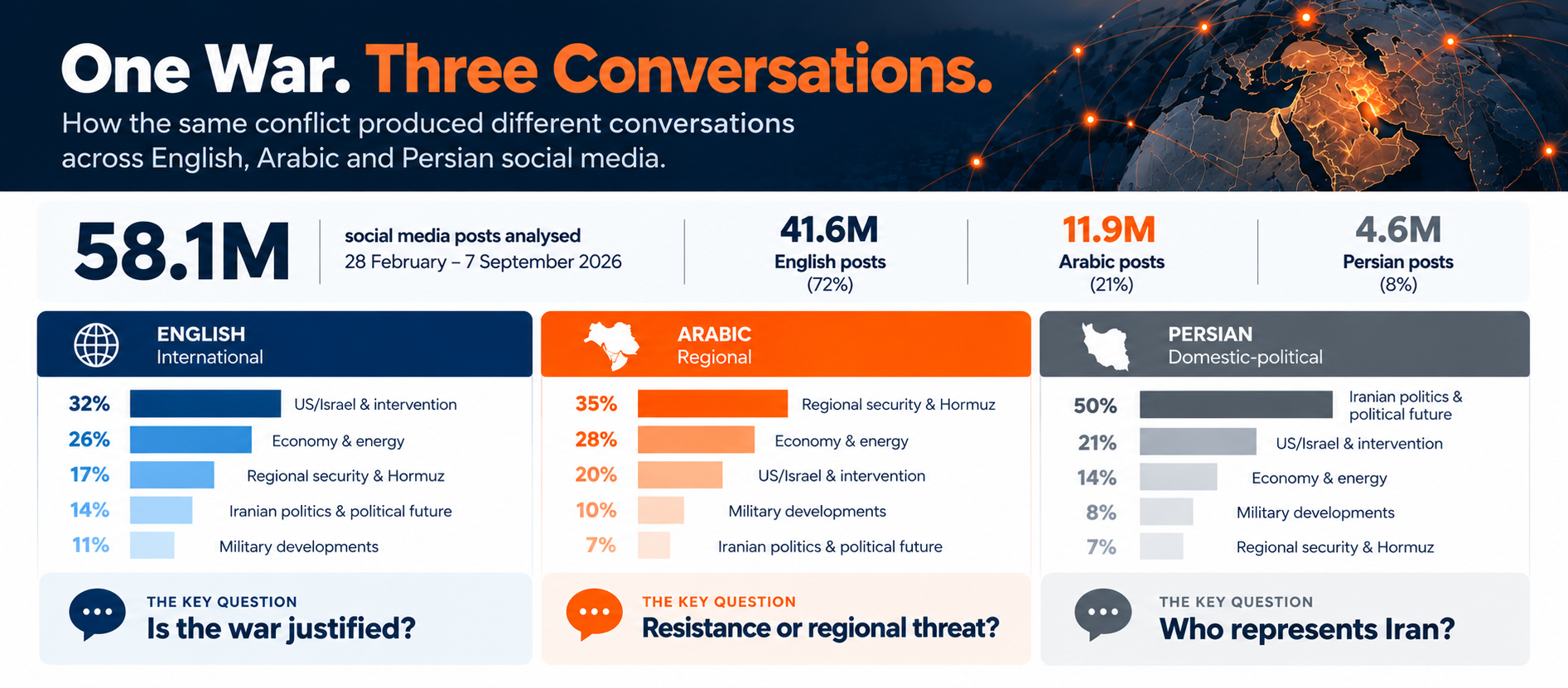
Social listening adds something conventional research often struggles to provide on its own: a timely view of spontaneous public conversation. It can reveal the themes people raise without prompting, the language they use, the emotional intensity around an issue and the narratives beginning to gain momentum.
Used well, it helps organisations detect emerging concerns, identify influential voices, track reactions and refine hypotheses before committing significant resources. It can also show when a message that performs well in one community is being interpreted very differently in another.
But speed should not be confused with completeness. Online conversations are not a representative sample of society. Platform behaviour, access, algorithms and highly active voices all shape what becomes visible. Social listening is most powerful when treated as a source of signals—not as a substitute for the public.
The objective is not simply to monitor more conversation. It is to interpret signals in context and test what they mean.
The case for a hybrid insight ecosystem
The strongest decisions come from combining methods that answer different questions. Social listening shows what is emerging and how it is being expressed. Quantitative surveys establish how widely a view is held and how it varies across priority groups. Focus groups and interviews explain the motivations, tensions and lived experiences behind the numbers.
Together, these methods form a hybrid insight ecosystem:
Listen: Capture real-time themes, sentiment, language, influential voices and emerging risks.
Measure: Use robust quantitative research to assess prevalence, awareness, perceptions and behavioural intent.
Explain: Use qualitative research to understand why people respond as they do and what may change their minds.
Act: Translate the combined evidence into audience choices, messaging, channel strategy and ongoing optimisation.
This approach is valuable because each method corrects the limitations of the others. Digital data adds immediacy and scale; surveys add structure and comparability; qualitative work adds depth and meaning. The result is a more defensible understanding of the audience—and a clearer basis for action.
Intelligence should travel with the campaign
Audience research is still too often treated as a front-end exercise: commissioned during planning, summarised in a deck and gradually separated from day-to-day decisions. That model is poorly suited to a communications environment in which sentiment, events and narratives can change within hours.
Target audience intelligence should instead operate across the full campaign lifecycle.
Planning
Define meaningful audience segments, identify priority motivations and barriers, test assumptions, shape the message and choose the channels most consistent with actual behaviour.
Execution
Monitor response in real time, identify which elements resonate or create confusion, compare reactions across audiences and detect emerging issues before they become established problems.
Optimisation
Connect communication signals with campaign outcomes, refine targeting and creative choices, and carry the learning into the next decision rather than restarting from zero.
The value of intelligence does not come from producing more analysis. It comes from placing better evidence close enough to the decision that it can change what happens next.
Four disciplines for more relevant campaigns
Organisations seeking to move from reach to relevance should build four disciplines into their operating model:
Begin with decisions, not dashboards: Define the choices the evidence must inform. A long list of metrics is not a strategy.
Treat audience language as data: The words people use reveal framing, identity and concern. They should inform message development, not merely appear as colourful quotations.
Validate before generalising: Use surveys and qualitative research to test whether visible online signals are widespread, concentrated or misleading.
Create a learning loop: Agree how insight will trigger action, who can authorise changes and how the impact of those changes will be assessed.
From communication output to strategic advantage
The organisations that communicate most effectively are not necessarily those with the largest media budgets or the highest volume of content. They are the ones that build a closer connection between evidence and execution.
That connection requires both technology and research judgement. It means listening at speed without mistaking noise for public opinion; measuring at scale without losing context; and acting continuously without chasing every fluctuation.
Reach will remain an important measure of distribution. It simply cannot carry the weight of effectiveness on its own. When audience intelligence brings motivations, concerns, behaviour and belief into the centre of campaign decisions, communication becomes more relevant, targeting becomes more precise and learning becomes cumulative.