How the same conflict produced different conversations across English, Arabic and Persian social media
The same event does not necessarily produce the same conversation.
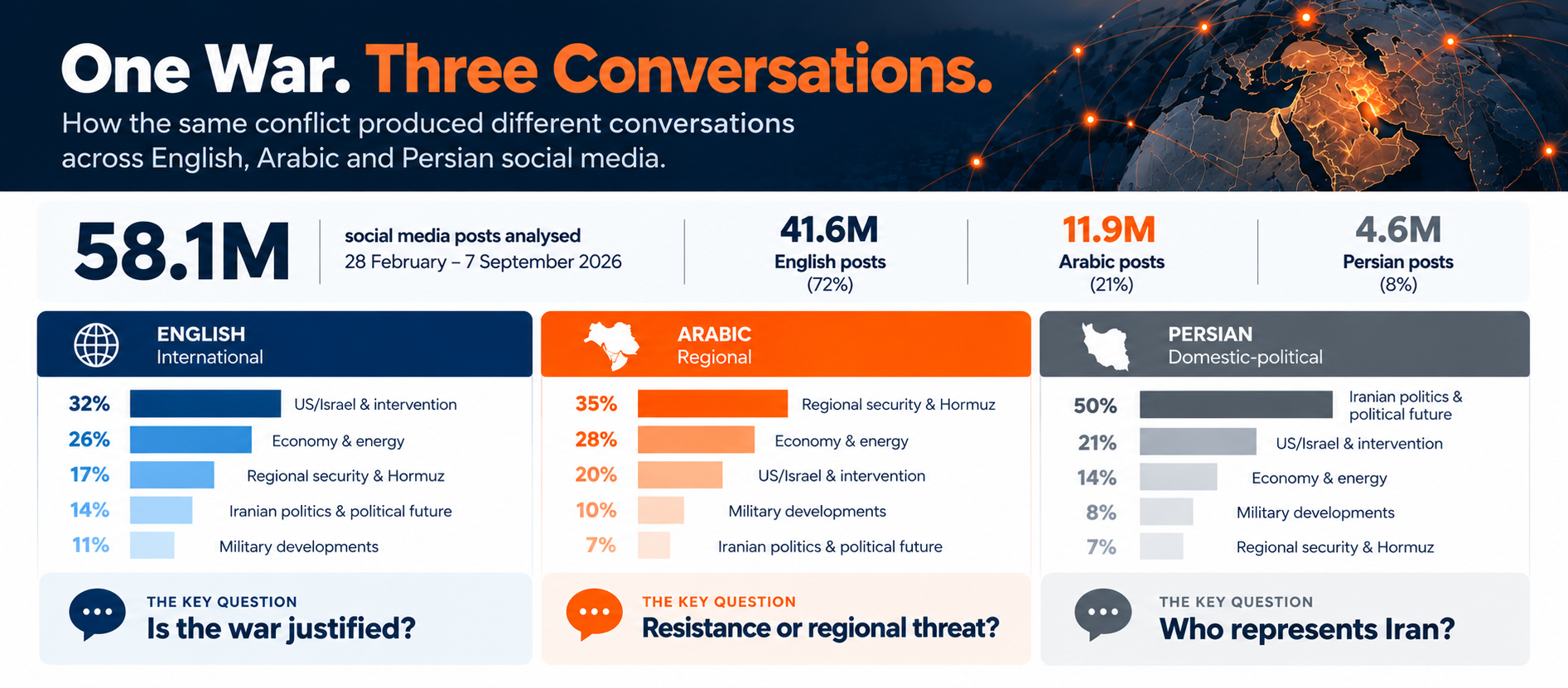
Investimate analysed 58.1 million social media posts about the war involving Iran across English, Arabic and Persian between 28 February and 7 September 2026.
While all three conversations concerned the same conflict, their centre of gravity was markedly different.
English conversation was predominantly international, focusing on intervention and global consequences. Arabic conversation was more regional, with security, the Strait of Hormuz and economic exposure playing a greater role. Persian conversation was more domestic-political, with half of the analysed posts centred on Iranian politics and the country's political future.
One conflict. Three different agendas.
The differences extended beyond the subjects receiving attention.
In English, the central political divide was largely about the war itself: 55% of politically positioned posts opposed the war or intervention.
In Arabic, the debate centred more on Iran's regional role: 58% of positioned posts framed Iran as a regional threat, while a substantial counter-narrative viewed it through the lens of resistance.
In Persian, the external conflict became much more closely connected to Iran's internal political future, with 57% of positioned posts favouring political change or expressing opposition to the Islamic Republic.
The result is an important distinction:
The three conversations were not simply producing different answers. They were debating different questions.
For English speakers: Is the war justified?
For Arabic speakers: Resistance or regional threat?
For Persian speakers: Who represents Iran?
Why this matters
For organisations operating across markets, simply translating the same research framework from one language to another can miss important differences in how an issue is understood.
Social listening can surface those differences early — identifying the narratives, language and political distinctions already emerging within a conversation.
It does not replace representative research. It helps us understand what we may need to ask.